Building Tradevo: An AI Trading-Intelligence Platform That Acts as a Mirror to the Trader
A Bluesoft case study on the engineering and product decisions behind Tradevo — the architecture, the explainability layer, the research-to-product separation, and the ML judgment calls along the way
Helping traders understand not just what happened, but why it happened — through explainable AI, execution-quality analysis, and personalized trading insights.
Most trading journals tell traders what happened — profit, loss, win rate, and trade history. What they don't explain is why a trade succeeded or failed, how much profit was left on the table, or whether better execution was realistically available.
Solving this problem required more than building another analytics dashboard. We needed to analyze complete trade lifecycles, measure execution quality against actual market opportunities, generate explainable insights traders could trust, and deliver all of it through a flexible analytics experience that adapts to different trading styles and strategies.
Our engagement: design and build the platform end-to-end — including exchange integrations, market-data infrastructure, the Execution Quality Analysis (EQA) engine, AI-powered insight generation, dynamic analytics, and the underlying ML architecture powering the intelligence layer.
“For each trade I closed, what was the best outcome that was actually available to me, and how did my decisions cost me the difference?”
What made this hard.
The architecture.
Tradevo is an AI trading-intelligence platform designed to help traders understand not just what happened in a trade, but why it happened. By connecting directly to exchange accounts, the platform ingests complete trading history and analyzes every position through a proprietary Execution Quality Analysis (EQA) framework.
The platform combines market data infrastructure, machine learning, execution-quality analytics, and natural-language insight generation to produce actionable coaching feedback. Rather than generating trading signals, Tradevo acts as a decision-support system — helping traders identify execution mistakes, missed opportunities, and recurring behavioral patterns.
Execution Quality Analysis (EQA)
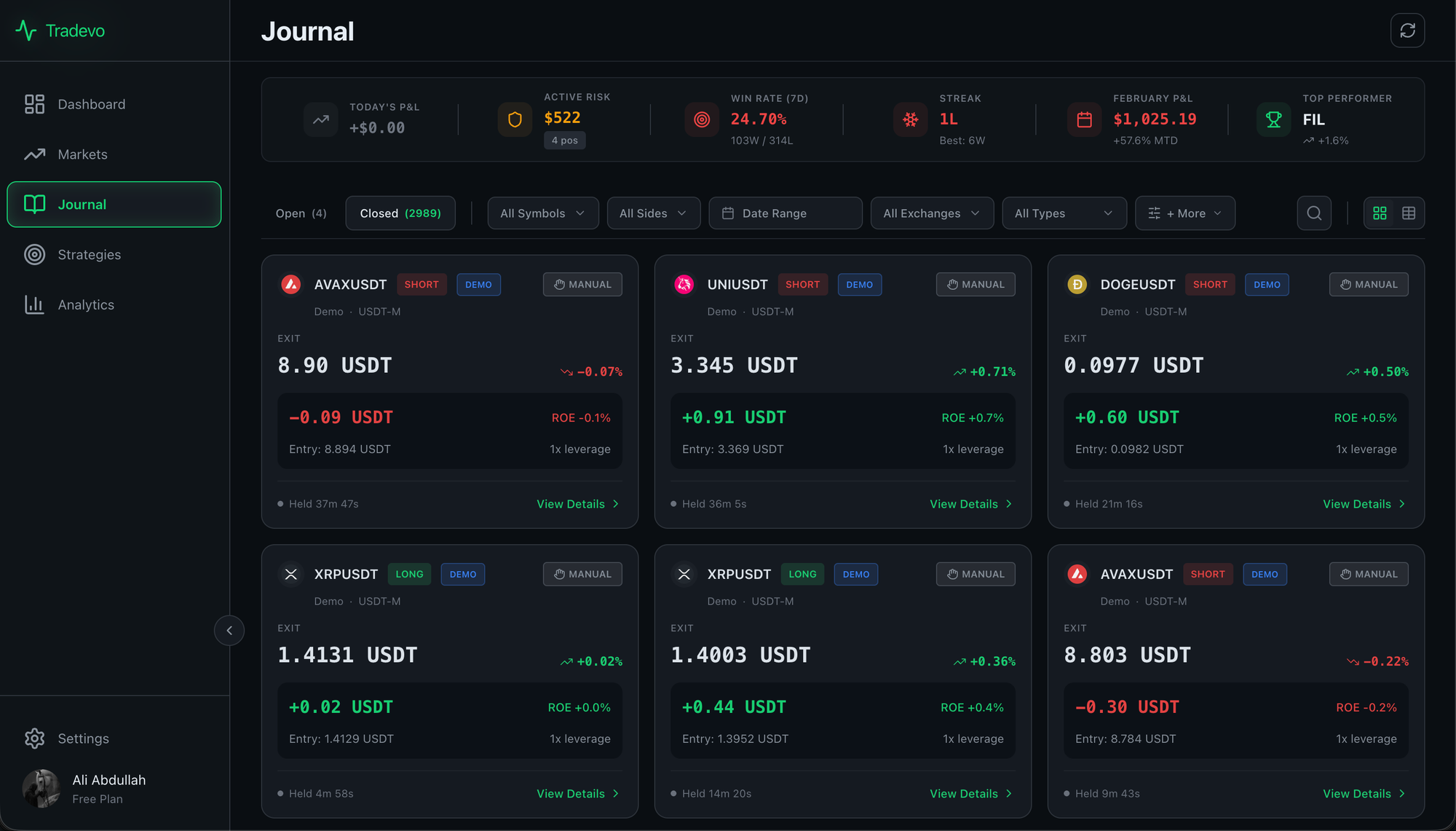
Every closed position is reconstructed using the full price path of the trade, not simply its entry and exit points. Tradevo calculates metrics such as maximum favorable excursion, maximum adverse excursion, capture ratio, entry quality, exit efficiency, and risk-adjusted performance.
These metrics are then translated into plain-English coaching insights, allowing traders to understand exactly where value was captured, where it was lost, and what alternative actions could have produced better outcomes.
A dynamic analytics engine
Instead of forcing every trader into a predefined dashboard, Tradevo provides a configurable analytics canvas. Performance metrics, visualizations, strategy breakdowns, and execution reports can be arranged and filtered according to individual trading styles and workflows.
This architecture allows scalpers, swing traders, and multi-strategy portfolio managers to analyze performance through entirely different lenses while operating on the same underlying data model.
Intelligence separated from execution
The platform was intentionally divided into three services: market-data infrastructure, intelligence and analytics, and trade execution. This separation ensures that analytical insights and machine-learning outputs remain isolated from execution controls and risk-management systems.
A dedicated safety boundary allows execution systems to reject actions regardless of upstream recommendations, ensuring that intelligence can inform decisions without ever controlling them.
Research distilled into product intelligence
Alongside the production platform, Bluesoft maintains an internal reinforcement-learning research environment focused on market behavior and position management. Experimental models never interact with customer capital or live execution paths.
Only validated outputs are surfaced through the Markets experience, where traders receive contextual intelligence, confidence indicators, and market observations designed to support decision-making rather than replace it.
What it looks like in production.
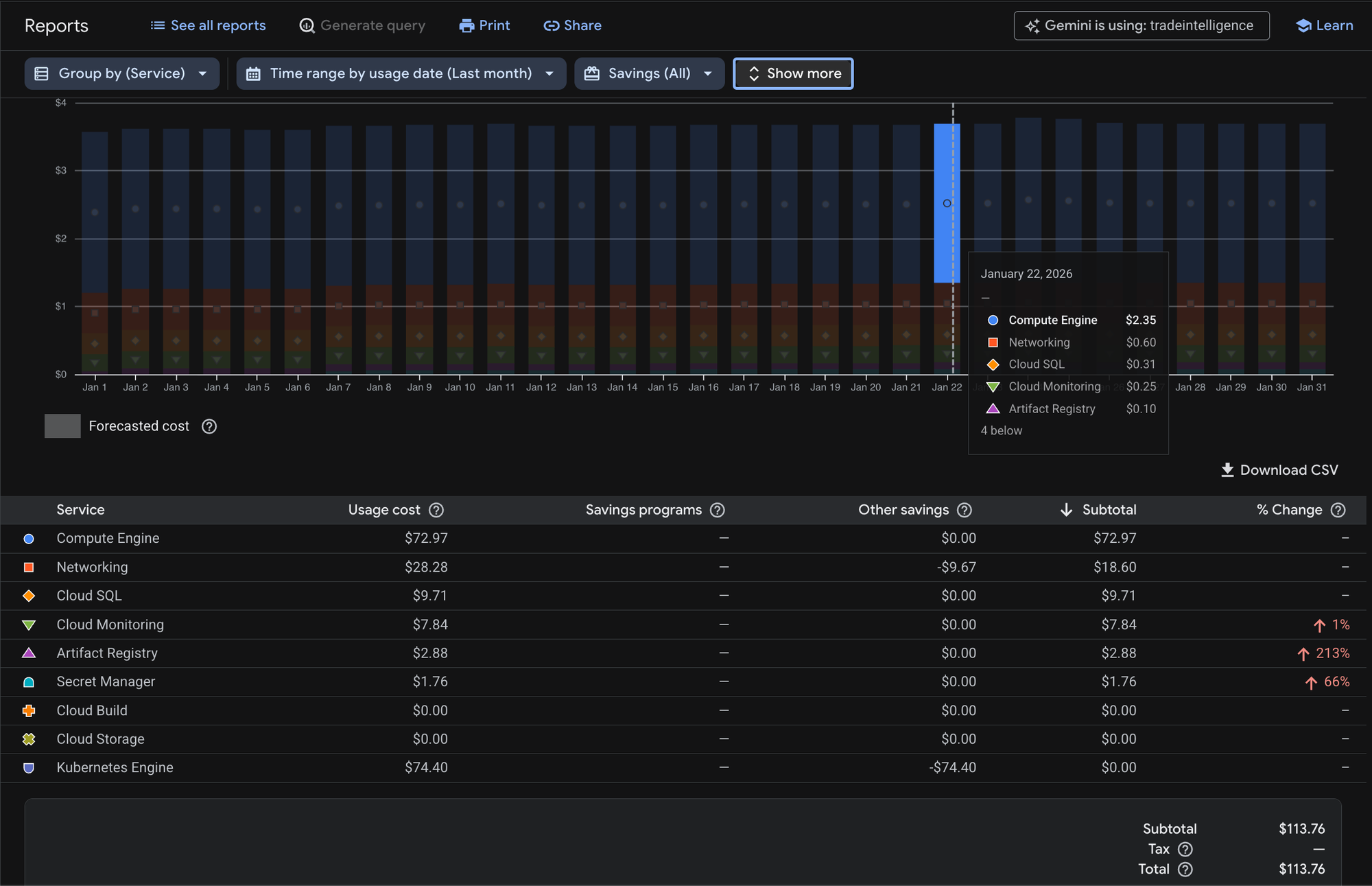
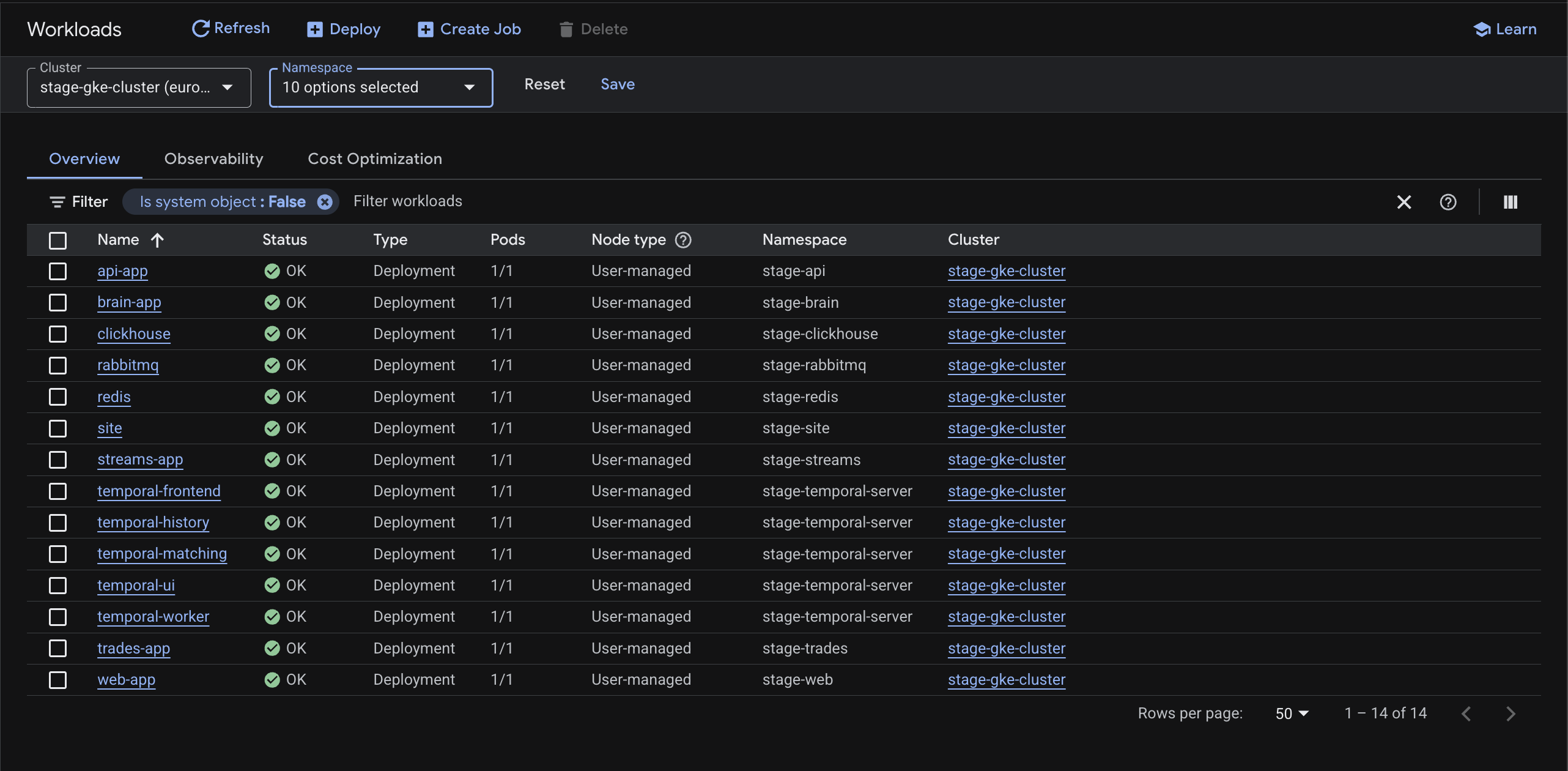
A few views from the production pipeline. Some details have been redacted for client confidentiality.
What we considered, and why we didn't ship it.
Every architectural decision had 2-3 alternatives we seriously considered. Here are the approaches we rejected and why:
Static dashboards vs dynamic analytics
Most trading products force every user into the same dashboard. We chose a widget-based analytics canvas where traders can build views around their own workflow, strategy, timeframe, and performance metrics.
Black-box AI vs explainable intelligence
Rather than surface unexplained AI scores, we built the Execution Quality Analysis engine. Every insight is tied to measurable metrics such as MFE, MAE, capture ratio, and execution efficiency, making recommendations traceable and actionable.
Unified service vs safety boundaries
Tradevo is intentionally split into ti-streams, ti-brain, and ti-trades. The execution layer can reject any action that violates risk controls, even if it originates from the analytics or ML layer.
Over-tuning models vs changing architecture
Our first LightGBM pipeline missed target precision and exposed a deeper architectural limitation: it could not understand sequence behavior. Instead of spending weeks tuning, we moved to a GRU-based sequence model designed to learn temporal patterns.
What shipped and what changed.
“Tradevo was never designed to tell traders what to buy or sell. It was designed to show them what actually happened, what opportunities existed, and how their decisions shaped the outcome.”
What we'd do differently next time.
Looking back, the highest-leverage decision was treating explainability as a core product requirement. Traders don't just need metrics; they need to understand why outcomes happened. The Execution Quality Analysis (EQA) engine became one of Tradevo's strongest differentiators because every insight can be traced back to measurable trading behavior
The second-highest leverage decision was enforcing a strict separation between market data, analytics, and execution. The architecture was designed around trust boundaries, not scalability alone. By ensuring the execution layer could reject actions regardless of where they originated, we created a safer and more resilient system.
If we started again today, we'd invest earlier in sequence-model research. The LightGBM phase taught us quickly that market behavior is fundamentally temporal. Recognizing that architectural limitation early saved weeks of optimization effort and allowed us to focus on models that could actually learn market context.
Have something like this you need to ship?
First call is 30 minutes. You describe what you're trying to ship and what's in the way. We ask technical questions and figure out together whether we're the right team for it.